Subtext in a screenplay: how to fix a scene where characters say what they feel
When a character says out loud what they feel (“I’m angry at you”, “I feel guilty”), the scene is left with nothing for the audience to discover. The fix is to cut those lines and let action, objects and what goes unsaid carry the same weight. Below you’ll see it step by step with one scene: the first draft, the note Aisen gave it, the rewrite and the second note.
What subtext is, in one sentence
Subtext is what a character feels or wants and doesn’t say. The audience discovers it through what they do, what they avoid and how they react. If the dialogue explains everything, there is nothing left to discover.
The first draft: everything is said out loud
INT. GRANDMA'S KITCHEN — NIGHT
LUCY, 30, comes in with a suitcase. Her brother DANNY, 27, is washing the dishes with his back to her.
LUCY
Hi, Danny.
DANNY
Hi, Lucy. Long time.
LUCY
Yeah. Three years. Since Mom died.
DANNY
I'm angry at you because you left and I was stuck looking after Grandma alone.
LUCY
I know. I feel guilty. That's why I came back.
Danny stops washing. He turns around and looks at her.
DANNY
Grandma doesn't remember you anymore.
Lucy doesn't answer. She sets the suitcase down on the floor, slowly.
The ending works. Everything else explains: Danny’s anger, Lucy’s guilt, the years that have passed and why she came back.
What Aisen said
Aisen read the scene and left this note:
What works The ending works: Lucy setting down the suitcase instead of answering Danny says more than a reply would, and it gives the actor something to play.
Push further Since you’ve already set the emotions on the table, try a pass where Danny’s anger shows through what he does with his hands at the sink, and Lucy’s guilt shows through how long she waits before coming further into the room — no labels at all.
Challenge Rewrite the dialogue scene cutting both lines ‘I’m angry at you...’ and ‘I feel guilty...’ — keep everything else, and find one physical action or one indirect line for each sibling that carries the same charge.
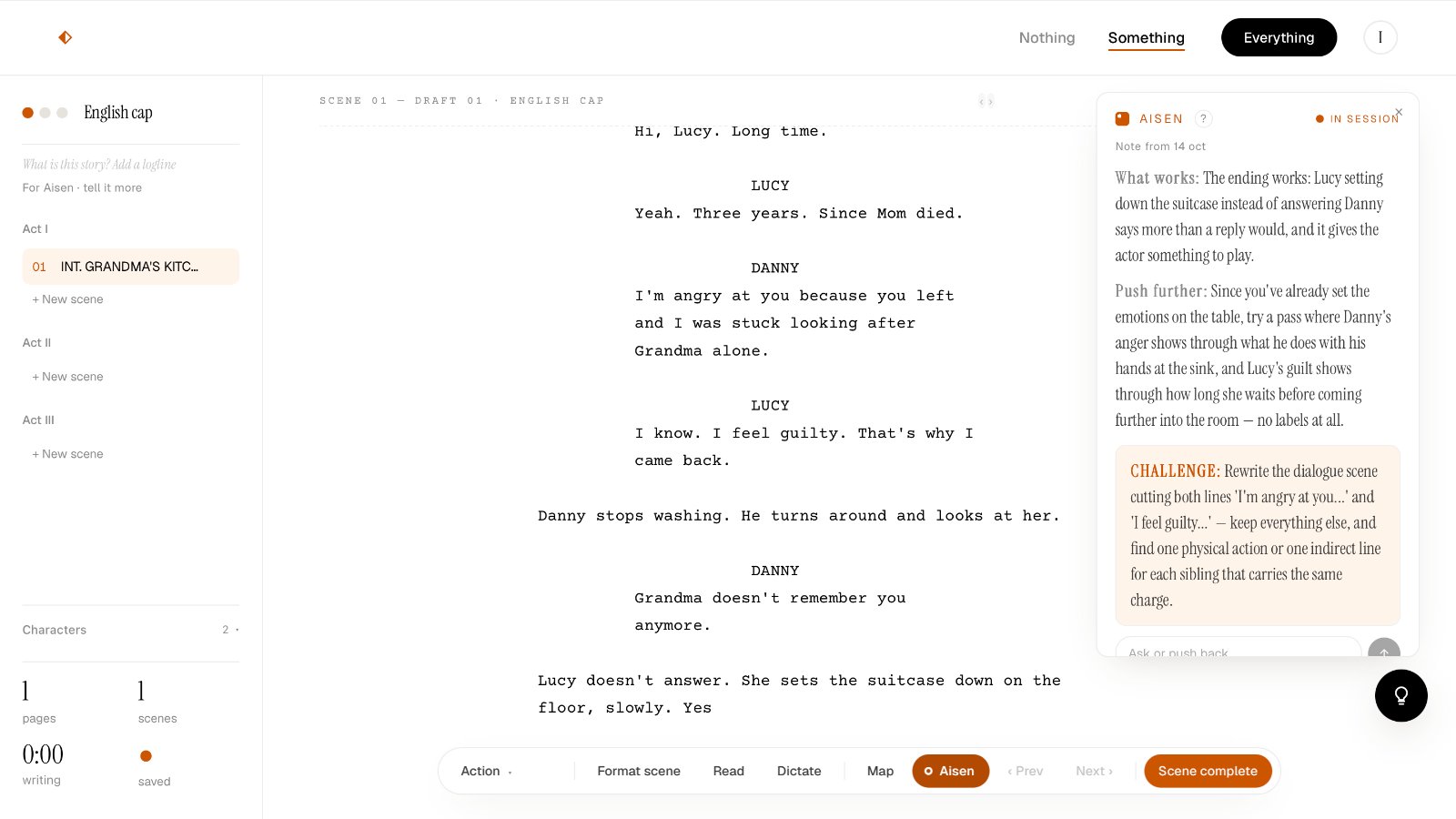
The note starts with what works, names the problem without rewriting anything, and turns it into a concrete task: one action per character instead of one confession per character.
Aisen remembers what it already told you
Before rewriting, we asked for another note on the same draft. Aisen didn’t repeat itself; it raised the bar:
Push further You’ve already been asked to cut the on-the-nose lines once; this time, try sending Lucy and Danny into physical business — him still at the sink, her not putting the suitcase down right away — so neither can look at the other while they talk.
Challenge Rewrite this so Danny never turns around until the very last line, and Lucy doesn’t set down the suitcase until she does — keep the dialogue as plain fact exchange (the three years, the leaving), but let the staying-turned-away and the holding-the-suitcase do the emotional work instead of the stated feelings.
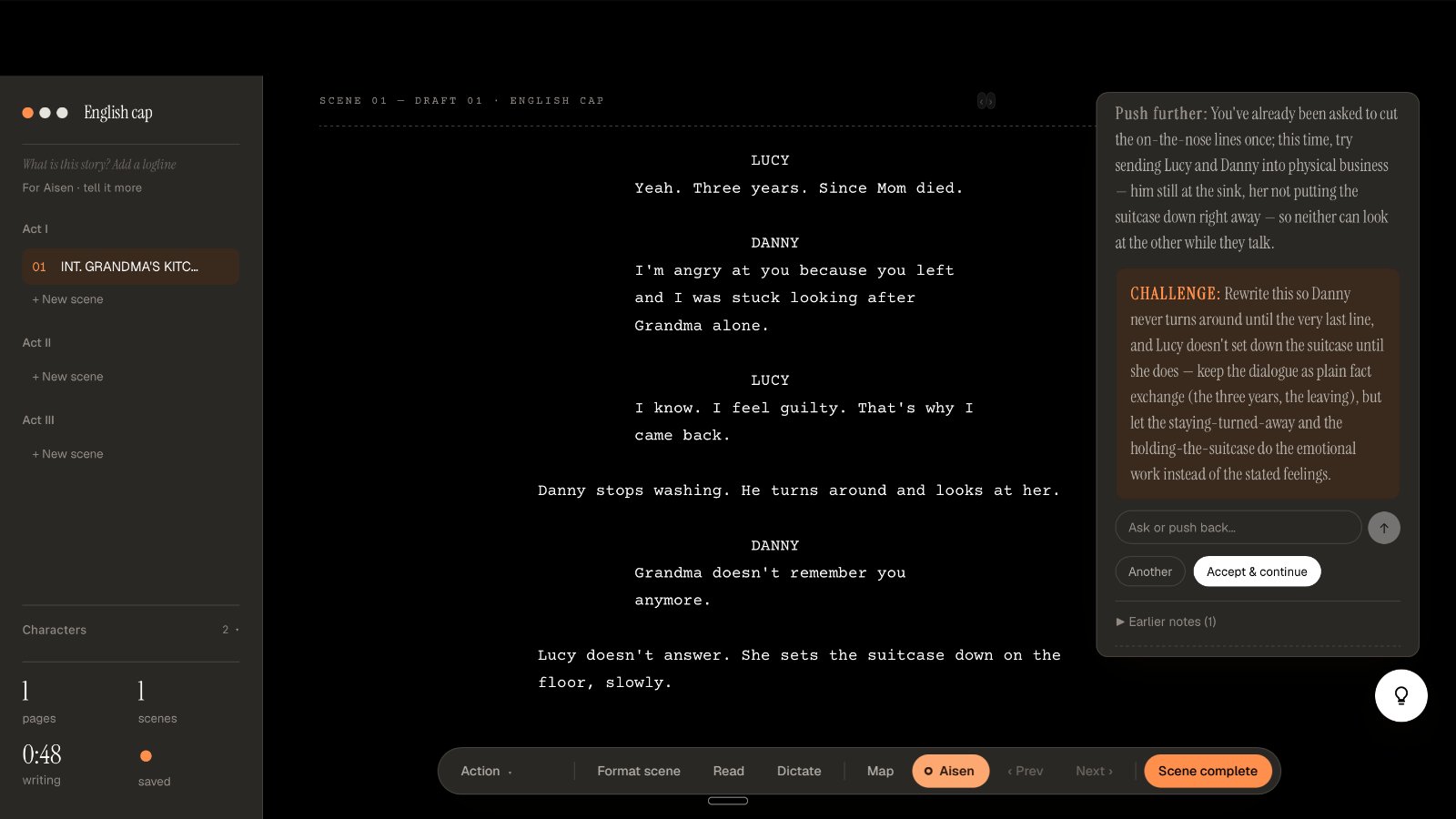
This is the most useful rule in the guide: for every line that names a feeling, ask what the character would do instead of saying it.
The second draft: the same thing, unsaid
INT. GRANDMA'S KITCHEN — NIGHT
LUCY, 30, comes in with a suitcase. Her brother DANNY, 27, is washing the dishes with his back to her.
LUCY
Hi, Danny.
DANNY
Hi, Lucy. Long time.
LUCY
Yeah. Three years. Since Mom died.
Danny scrubs the same pot. Harder. Water spills over the rim onto the floor. He doesn't turn off the tap.
Lucy stays in the doorway, the suitcase still in her hand. She doesn't take off her coat.
Danny stops washing. He turns around and looks at her.
DANNY
Grandma doesn't remember you anymore.
Lucy doesn't answer. She sets the suitcase down on the floor, slowly.
| What was said | How it’s told now |
|---|---|
| “I’m angry at you” | Danny scrubs the same pot harder and lets the water spill over. He doesn’t turn off the tap. |
| “I feel guilty” | Lucy stays in the doorway, suitcase in hand, coat still on: she hasn’t decided she’s allowed to stay. |
| “That’s why I came back” | The suitcase she finally sets down on the floor, slowly. |
The second note: the subtext works, now find what he wants
What works The physical details carry the tension well — the overflowing tap Danny won’t turn off, Lucy who won’t take off her coat or set down the suitcase until that last line. You’re trusting behavior over explanation, which is the right instinct here.
Push further Right now Danny’s line lands as pure hostility — figure out what he actually wants from Lucy in this moment, because that’s what will tell you what she does with the suitcase next.
Question When Danny says Grandma doesn’t remember her, is he trying to push Lucy away, or is he testing whether she’ll stay anyway? That answer will shape everything he does next.
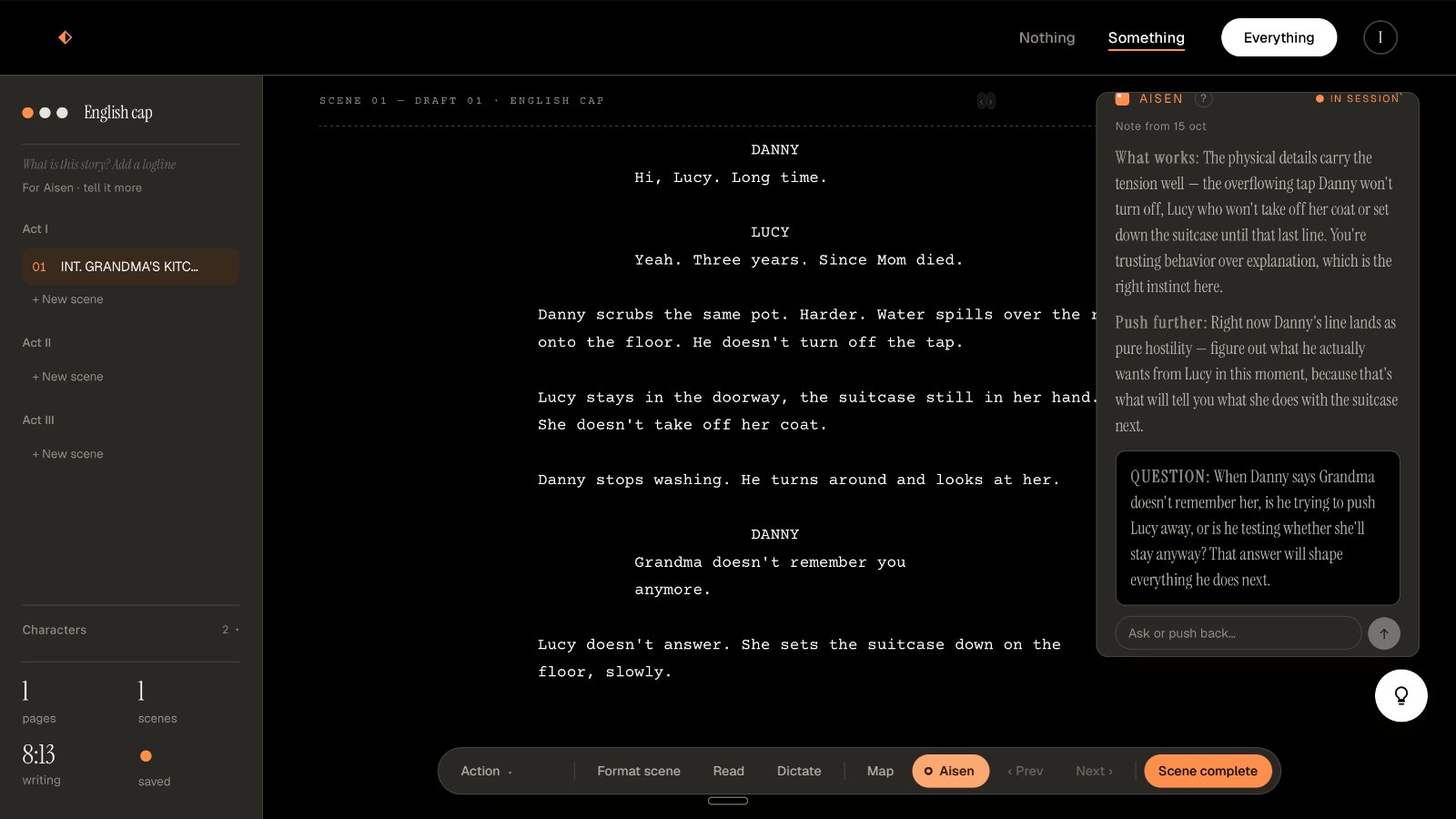
The second note no longer talks about what is said. It accepts the tap and the coat and moves on to something finer: what Danny wants. There is no right answer to its question; there is a decision, and it belongs to the writer.
Three checks for your next scene
- Does any line name a feeling? Ask what the character would do instead of saying it.
- Is there an object that can carry the story? A suitcase that stays in a hand, a tap nobody turns off.
- What does each character want in this moment? The answer tells you what they do next.
Try it with your own scene
In Aisenscript you do the writing. When you mark a scene as complete, Aisen leaves a note like these: what works, what to push, and a question or a challenge. It never writes for you, and it talks to you in the language you use the app in. If you want to practise exactly this, the Projection Room has a session on it: “Nobody says the thing”.
Start writing for free