Feedback on every scene of your screenplay
In Aisenscript you write the scene. When you mark it as complete, Aisen, the mentor inside the app, reads it and leaves one note: what works, what to push, and a question or a challenge. No rewrite, no score. The decisions stay with you.
What one note looks like
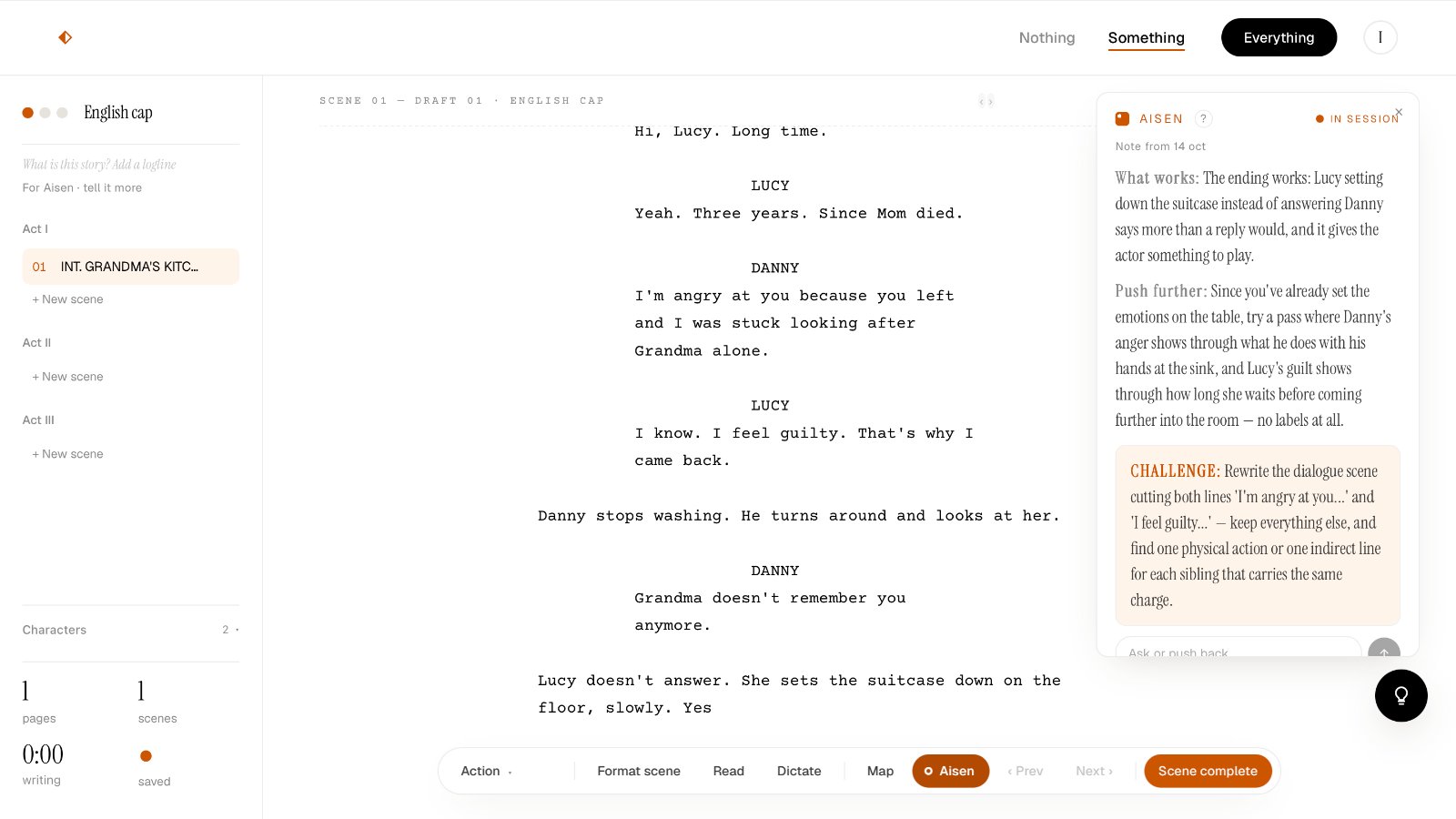
This is a real note, copied without editing, on a first draft where two siblings say out loud everything they feel:
What works The ending works: Lucy setting down the suitcase instead of answering Danny says more than a reply would, and it gives the actor something to play.
Push further Since you’ve already set the emotions on the table, try a pass where Danny’s anger shows through what he does with his hands at the sink, and Lucy’s guilt shows through how long she waits before coming further into the room — no labels at all.
Challenge Rewrite the dialogue scene cutting both lines ‘I’m angry at you...’ and ‘I feel guilty...’ — keep everything else, and find one physical action or one indirect line for each sibling that carries the same charge.
The full example, with the rewrite and the second note, is in the guide Subtext in a screenplay.
How it works
- You write the scene on a page that formats itself.
- You press “Scene complete”. Aisen reads that scene together with the three before it, the characters who speak in it and what you told it about your film in “For Aisen”: the theme, the tone, what the audience should feel.
- It leaves one note. What works, what to push, and a challenge when the page can take it or a question when it needs to understand what you intend.
- You can answer back. Tell it why you wrote it that way and it replies to that.
- Tap “Why?” to see the principle behind the note, where it comes from, and the Projection Room lesson that practises it.
It remembers what it already told you
Ask for another note on the same draft and Aisen does not repeat itself. On the scene above, it raised the bar:
Push further You’ve already been asked to cut the on-the-nose lines once; this time, try sending Lucy and Danny into physical business — him still at the sink, her not putting the suitcase down right away — so neither can look at the other while they talk.
Challenge Rewrite this so Danny never turns around until the very last line, and Lucy doesn’t set down the suitcase until she does — keep the dialogue as plain fact exchange (the three years, the leaving), but let the staying-turned-away and the holding-the-suitcase do the emotional work instead of the stated feelings.
What it never does
- It never writes your story. Not a line of dialogue, not a scene. Its notes are never inserted into your draft.
- It does not give you a score. It tells you what works and what to try next.
- It only reads what you finish. Nothing is read until you mark the scene as complete, and an empty scene does not use a note.
How many notes you get
Writing is free. Aisen’s notes run on a weekly allowance, because each one has a real cost. On Free, that is about ten scene notes in your first week, then about four a week. Pro is €9.99 a month or €96 a year and raises it to about sixty a week. The numbers are approximate, because a long scene costs more to read than a short one.
Who it is for
Anyone writing for the screen, with most care for whoever is starting: a first short, a first feature, a pilot that stalled. Aisen talks to you in the language you choose for the app.
Get a note on your next scene
Write it, mark it as complete, and read what Aisen says. It never writes for you.
Start writing for free